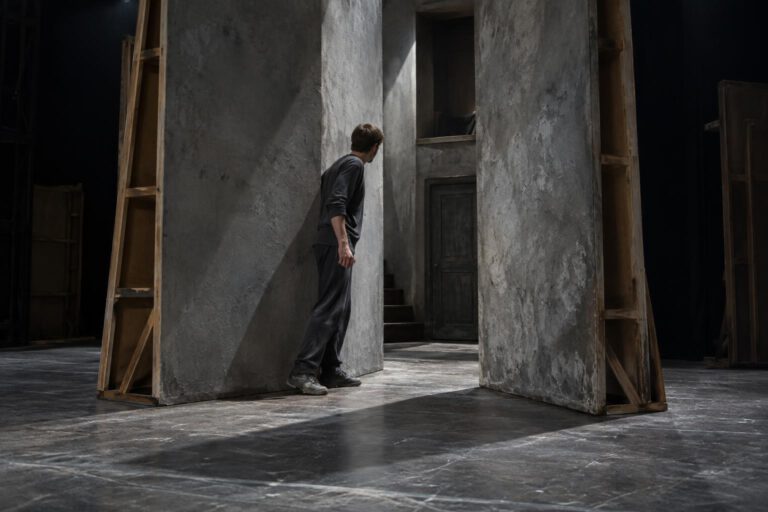
A ballet is not an object that can be taken out of an archive and placed on stage unchanged. It lives in bodies: in sequences of movement, musical cues, glances and transitions passed on from one generation to the next. John Cranko’s Romeo and Juliet is a particularly telling example. Stuttgart Ballet is presenting the work at the Opernhaus on 13 and 15 November 2026; the performances offer an occasion to consider the continuing life of a choreography — not a premiere.
Cranko created the ballet after William Shakespeare for Stuttgart Ballet; its world premiere took place on 2 December 1962. Sergei Prokofiev’s music and Jürgen Rose’s sets and costumes are among the production’s defining elements. The John Cranko Foundation dates a revised version to 27 October 1967. This history alone is a reminder that passing a work down does not necessarily mean that everything has remained unchanged since the first night.
Not just steps, but relationships
A narrative ballet must tell a story without relying on spoken dialogue. Cranko’s version makes characters and conflicts legible through movement: who seeks closeness, who draws away, when does a game become a threat? In the pas de deux, the lovers’ relationship takes physical form; fencing scenes and large group tableaux, by contrast, place the violence and social pressure of the feuding families centre stage. Stuttgart Ballet describes the clearly drawn characters and dramatic structure as hallmarks of the work.
What is passed on, then, is not merely a sequence of positions. Timing, weight, the direction of a gaze and coordination between the dancers are equally important. A step can be technically correct yet have a different effect if its impulse, duration or the other dancer’s response changes. The task of staging the work is therefore to bring the movement material together with its dramatic function. Precisely how this is currently being done in Stuttgart cannot responsibly be described in detail without speaking to the team there.
Preserving means passing on
When a choreography’s creator is no longer there in person, those staging it take on a mediating role. They pass on the inherited form, explain sequences and help clarify the relationship between movement and scene. Written dance notation can also document movement, but it cannot entirely replace the practical transmission of a complex stage work. Notation records, above all, what can be described. Musical sensibility, dramatic intention and the precise coordination of the ensemble must come alive in rehearsal.
This is neither free reinvention nor mechanical copying. Every cast brings different bodies, experiences and partnerships. The roles remain rooted in a prescribed choreography; within that form, however, dancers can still place different emphases. With Juliet and Romeo in particular, the impact of a pas de deux depends on how two people perceive and respond to one another. Such differences are not automatically departures from the work. They can reveal its possibilities — as long as the choreographic structure remains recognisable.
A repertoire is also a memory
Cranko’s Romeo and Juliet is among the works that have shaped Stuttgart Ballet’s international profile. The foundation lists numerous companies that have added the ballet to their repertoire. With each new staging, it enters a new institutional and physical context; the Stuttgart performance remains a point of reference, but not every production is identical.
In a repertory company, passing a work on becomes a recurring task. Casts change, roles are rehearsed afresh, and an ensemble must find a shared language. The piece does not remain alive, then, because all change is ruled out. It lives when its inherited form is understood by the dancers performing it and invested with a presence rooted in the present. The November performances in Stuttgart make this tension visible: between a choreography that has been passed down for decades and the people who embody it anew, night after night.
Original reviewed by the editors · 1 November 2026