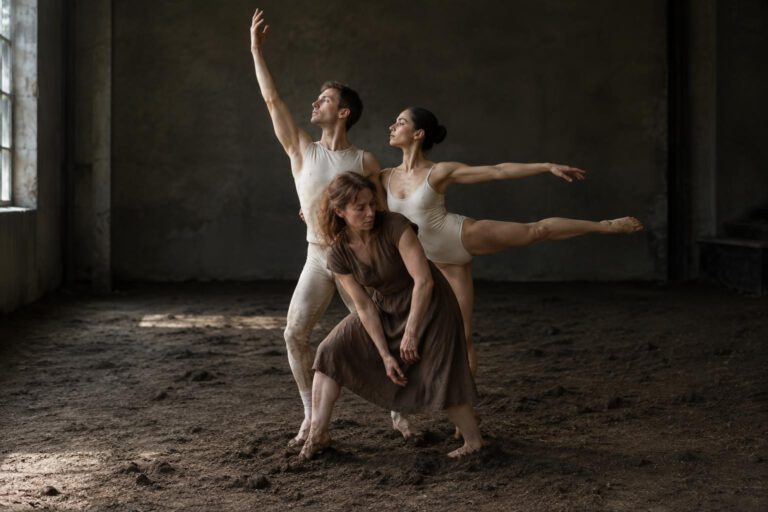
Judith Kuckart did not take a direct route to the novel. Before arranging sentences at her desk, she worked with bodies in space: as a dancer, choreographer and director of an independent ensemble. What passed from this practice into her prose was less a stock of stage images than an attentiveness to posture, movement and what people leave unsaid. On 10 November, Kuckart will receive the 2026 Wiesbaden Literature Prize at the thalhaus Theater – an award that draws attention to the connection that has shaped her work for decades.
Born in Schwelm in 1959, Kuckart studied literature and theatre studies and trained as a dancer. In 1984, she founded the dance theatre company Skoronel in Berlin with four other ensemble members. Its first production, “Kassandra” (Cassandra), took Christa Wolf’s novel as its starting point. By 1998, the company had created seventeen productions; Kuckart developed material and choreography, and later also wrote and directed her own plays. As she describes it on her website, the work sought to make body language and poetic language felt as a single whole.
From body to sentence
The transition to literature was not a farewell to the stage, but a shift in material. In an autobiographical text, Kuckart describes how she began writing her own texts for the ensemble in 1989: assembled sentences became longer passages, and working on them eventually gave rise to the desire to write a novel. Her first novel, “Wahl der Waffen” (Choice of Weapons), appeared in 1990. Daily training gradually gave way to sitting down at her desk each day – a practised regularity remained.
Here lies a key to Kuckart’s working method: writing emerges not as an alternative world to dance, but as another form of practice. Where the stage organises movement and language simultaneously, prose must turn movements into something imagined. A glance, a gesture, a hesitation can carry the action without needing explanation. This is one reading of her development, not an equation of the two arts: the novel has different means and a different sense of time. Yet Kuckart’s own account makes clear that the move from rehearsal room to writing desk also preserved a continuity.
Storytelling without standing still
In her novel “Die Welt zwischen den Nachrichten” (The World Between the News), published by DuMont in 2024, Kuckart interweaves personal memory with political and historical events. The title already suggests a method: life does not unfold independently of the news of its time, but nor can it be reduced to it. Private experience and public history find themselves side by side, touching and shifting in meaning. The book is autobiographically inspired, yet its storytelling makes no claim simply to depict a life as an unbroken chronicle.
On stage, too, Kuckart looked beyond fixed forms. Skoronel had no permanent venue, but it did have a stable ensemble of actors, dancers, singers and musicians. Changing locations and the search for an interplay between movement and language were among the conditions of this work. Kuckart has been a freelance director since 1999; in 2021, she brought former members of Skoronel together for a new joint project. The reunion with the group was thus also a return to a way of working in which different voices and bodies contribute to a narrative.
In an interview, Kuckart described dance as something inscribed in the body: a posture changes how one enters a room or a situation. For literature, this does not mean that every sentence is a piece of choreography. Rather, what remains is a sensitivity to the fact that people speak through more than what they say. The body contradicts, remembers, pauses. Kuckart’s writing draws its distinctive agility from this tension: it does not simply lead from beginning to end, but allows experiences to stand alongside one another until a story begins to emerge between them.
The Wiesbaden Literature Prize honours authors who establish connections between literature and other art forms. In Kuckart’s case, this connection is not an award criterion applied after the fact. It is part of her development: from dance theatre, in which texts gradually took up more space, to a prose that does not disavow its origins in movement. What passes from dance into storytelling is ultimately a working principle – to look closely at how people reveal themselves, and to give language enough room for something more than an explanation to emerge.
Original reviewed by the editors · 4 November 2026