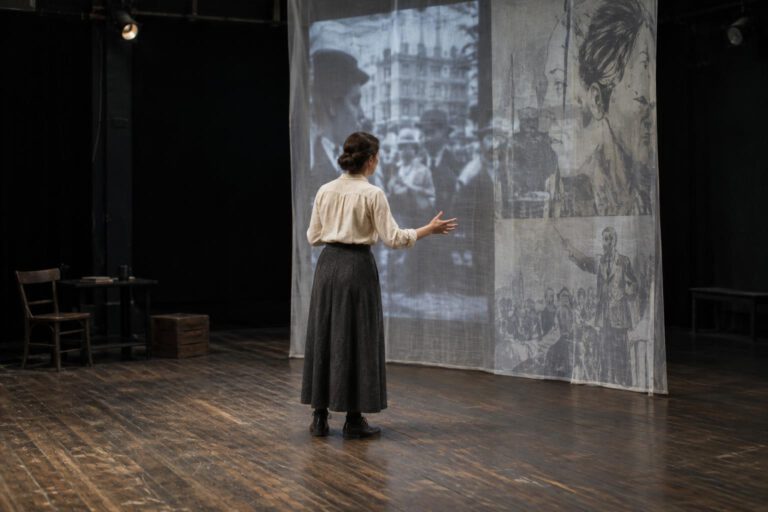
The cinema release of Sandra Prechtel’s documentary ‘Einar Schleef – Ich habe kein Deutschland gefunden’ (Einar Schleef – I Found No Germany) on 5 November does more than commemorate a theatre-maker. The film also poses a question about remembrance itself: what happens when a life is brought into the present primarily through images and voices from archives? The material is not merely evidence of the past. Through the editing, it emerges as an interlocutor – with ruptures, repetitions and all that can no longer be heard or seen.
Schleef, born in Sangerhausen in 1944 and deceased in Berlin in 2001, was a painter, stage designer, director and writer. His life spanned two German states without fitting into a simple narrative of East and West. He initially worked in the GDR, moved to the West in 1976 and later returned to the major stages as a director. For him, questions of home, belonging and German history were no mere backdrop. They ran through his work.
An artist who brought back the chorus
Schleef’s theatre is particularly associated with a form that modern drama had long pushed to the margins: the chorus. In his production ‘Mütter’ (Mothers) at Schauspiel Frankfurt, created in 1986 using motifs from ancient tragedies, the group did not become a backdrop for individual protagonists. Bodies, voices and rhythms could themselves become the dramatic event. In this way, Schleef shifted the familiar perspective: not only the individual character but also the collective, its force and its conflicts, were to be made visible on stage.
This aesthetic was controversial. It could overwhelm, but also unsettle; choral speech could not be reduced to individual psychological destinies. Schleef’s theatre asked how history continues to exert its influence in bodies and groups – and how a society speaks when many speak at once. Particularly in post-war Germany, whose self-images were shaped by repression and competing memories, this was no neutral question of form.
Archives rather than retrospective explanation
According to filmportal.de, Prechtel’s film tells Schleef’s life story largely through archival material that lets him speak for himself. This changes the role of the documentary. A judgement recorded after the fact could smooth over the contradictory traces of a life. The surviving voice, by contrast, remains bound to its particular moment: to a camera, a conversation, a public setting. It is both testimony and performance.
This places a particular responsibility on the editing. Those who select material establish relationships: between a statement and an image, between different periods, between what Schleef says about himself and what others say about him. The sequence can open up connections, but it can also create a certainty that the individual fragment does not possess. The archive, then, does not speak for itself. Selection and editing make it legible – and the selection remains part of the statement.
Against the seamless life story
A portrait of Schleef has to contend with a contradiction: he was an influential, much-discussed theatre-maker, yet remained difficult to categorise. His own voice can create intimacy, but it is no substitute for independent contextualisation. An archival film, too, is therefore not automatically detached. Images preserve something, but they do not show everything; some perspectives have survived, while others are missing. What is absent from the material cannot be recovered through editing.
It is precisely here that the form can become productive. Rather than declaring Schleef a closed chapter in theatre history, the film keeps open the distinction between the artist and the images of him that remain. For film history, this is a precise task for the documentary archive: it should not merely illustrate what we already know. It can reveal how we arrive at our knowledge – and where that knowledge remains fragile. Schleef’s works revolved around the tension between individuals and the collective. A film that makes his voice audible again through the surviving records faces a related question: who speaks when the past returns?
Original reviewed by the editors · 4 November 2026