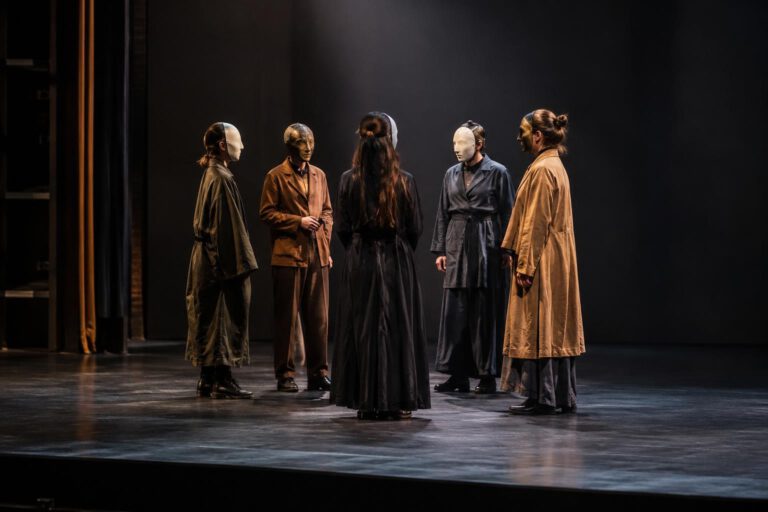
On 7 November, a boarding school opens on the Kleine Bühne at Theater Basel where intimacy and strictness are almost impossible to tell apart. Anne Haug stages Fleur Jaeggy’s “Sweet Days of Discipline” with Elmira Bahrami, Dominic Hartmann and Bärbel Schwarz; Luzius Schuler composes and performs live. The German-language premiere takes a short, austere prose text as its starting point – and poses a theatrical question: how can a voice be made visible when it circles around its feelings rather than expressing them?
The novel takes us into a girls’ boarding school in Appenzell. Obedience and rituals structure daily life; the unnamed narrator focuses her attention on Frédérique, a new classmate who is at once alluring and aloof. When Frédérique disappears, their encounter becomes an absence that shapes later recollections. This is no coming-of-age story that neatly explains its experiences in retrospect. Jaeggy’s prose holds them in a controlled, almost unapproachable state of suspension.
The chill between the sentences
This is precisely where the challenge of the stage adaptation lies. A novel can interweave thoughts and recollections without releasing the narrator from her solitude. On stage, such movements must find a form: through language, bodies, rhythm, space – or through what remains unsaid. Will the memory be spoken as an account? Will the production distribute the voice among several characters? And how can it portray a relationship whose tension stems largely from unattainability?
These are open questions, not descriptions of scenes already seen. Theater Basel lists Moïra Gilliéron for set and costumes, Stefan Erny for lighting design and Schuler for the composition. Only the performance will reveal the specific choices they and Haug make. In any case, casting three performers opens up the possibility that characters, memory and the present need not simply correspond one to one.
Discipline as a temptation
Jaeggy’s boarding school is more than an enclosed setting. Its order gives daily life a fixed form – and in doing so acquires a disturbing allure. The narrator seeks intimacy and recognition, yet also succumbs to the appeal of the discipline surrounding her. Her desire is not for an uncomplicated friendship: Frédérique remains a stranger, and it is precisely this distance that binds the narrator to her.
First published in Italian in 1989, the text appeared in Barbara Schaden’s German translation in 1996. Its brevity and consistently restricted perspective make it striking, but by no means straightforward, material for adaptation. A stage version need not retell every episode of the plot. More interesting is how it organises the relationship between looking and being looked at: who gets to speak, who is observed, and how does memory change when it is given a space and several bodies?
A memory without resolution
With this work, Haug returns to Swiss material after Fritz Zorn’s “Mars”; the theatre’s season announcement describes the production as a chamber drama poised between discipline and friendship. That promises a concentrated form, but says nothing yet about the actual effect of the evening. Even the dating of the boarding-school years is inconsistent: the theatre’s webpage gives the 1950s, while the season programme gives the 1960s. What is certain is the central conflict: an adolescent girl recalls a bond whose power arises from intimacy and withdrawal alike.
On stage, the crucial question will be whether this memory becomes an explanation or an experience of something that cannot be resolved. Jaeggy’s language offers no simple key to her characters. Its coolness is not a lack of feeling, but a way of keeping feeling at a distance. The premiere may reveal what means theatre finds not merely to illustrate that distance, but to make it palpable between voice, body and space.
Original reviewed by the editors · 6 November 2026