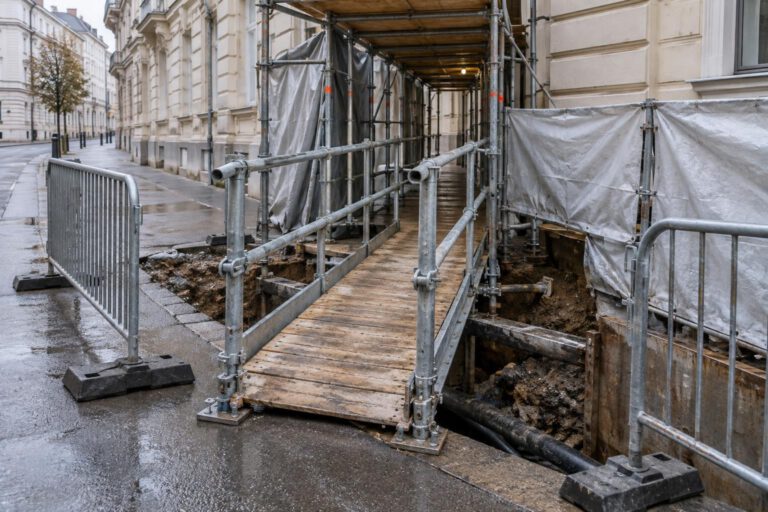
Scaffolding is intended to stay up for a limited time. It protects passers-by, supports netting, sheeting or cables – and disappears once the work behind it is done. Yet in the city, timescales rarely align so neatly: construction takes longer than planned, a diversion stays in place, a temporary space becomes the only available solution. When is the provisional a smart response, and when is it merely another name for deferred responsibility?
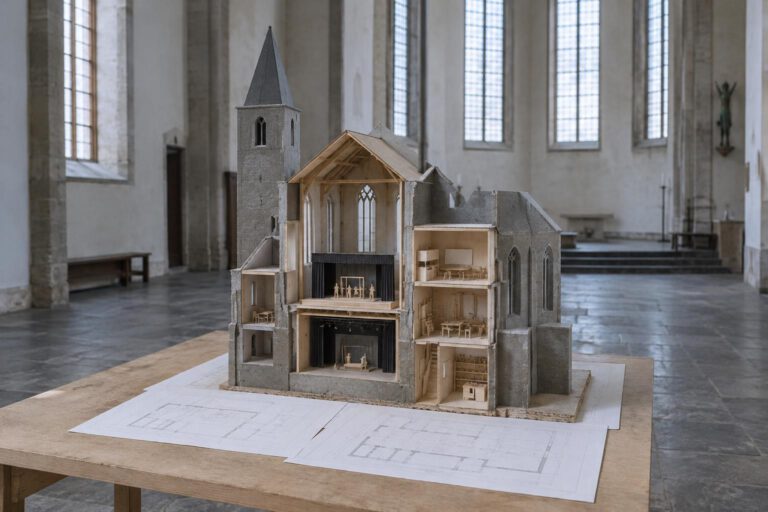
The exhibition ‘Temporär. Strukturen der Notwendigkeit’ (Temporary. Structures of Necessity) at the Architekturzentrum Wien, which opened on 4 November 2026, looks beyond large buildings to bring an everyday technical layer into focus: structures for construction sites, maintenance, wayfinding and protection. KOSMOS Architects are responsible for the concept and design. The institution describes such structures as readily available, adaptable and dismantlable. This raises an important question – but offers no guarantee that temporary automatically means resource-efficient or socially equitable.
Quick to Build – Not Necessarily Light
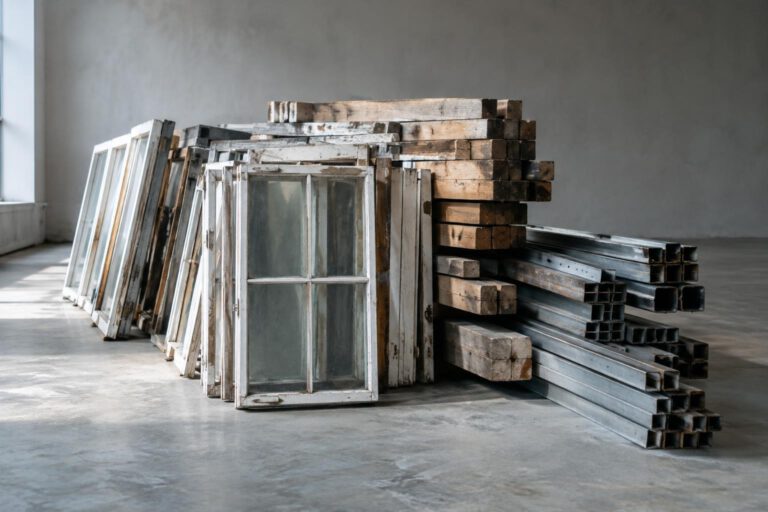
A temporary solution has a practical advantage: it can respond to a specific, urgent need without waiting for a lengthy new-build project. Scaffolding and protective roofs enable repairs, barriers organise routes, and mobile elements can be deployed wherever a situation is changing. When components are assembled with simple connections, dismantled and reused elsewhere, materials can remain in circulation for longer.
But ‘light’ is not an environmental assessment. What matters is not just how quickly an element can be put up, but what it is made of, how long it is needed, whether it can be used repeatedly and what happens to it after dismantling. The European Commission highlights the value of reuse and selective dismantling in the construction sector; the benefit therefore comes not from the label ‘temporary’, but from planning across the entire life cycle. Even a short-term structure requires transport, manufacture, maintenance and, ultimately, a way of dealing with residual materials.
When the Exception Becomes Everyday Life
The more critical situation begins when use is extended but the original remit does not expand with it. Emergency accommodation, a temporary school or provisional services may be urgently needed. If this becomes a situation lasting years, more is required than a robust shell: reliable water and energy supplies, accessible entrances, safe routes, maintenance and a say for users. In relation to housing people in crises, UN-Habitat stresses that, in protracted situations, housing must be treated as a development issue, rather than solely a humanitarian one.
The problem then lies not in the temporary solution itself. It lies in institutions continuing to assume a short transitional period while people live in it permanently or the infrastructure is needed on a lasting basis. Flexibility can thus become an excuse: operations are improvised, responsibilities remain temporary, and investment in lasting solutions is deferred. A structure may be technically easy to dismantle; its social consequences are not.
A Different Approach to Time
The productive alternative is not to replace every temporary structure immediately with a permanent building. Permanent buildings, too, can be oversized, energy-intensive and difficult to adapt. In its guidance on decarbonisation, the European Commission recommends considering the whole life cycle of buildings and making better use of existing ones. For temporary structures, this means establishing from the outset who will use them, how long they are likely to be needed, who will maintain them and which components can subsequently be reused.
A good temporary solution, then, is not merely quick to erect. It is designed with a clear end point or a deliberately planned transition in mind. If needs change, services and funding must expand accordingly – or a viable permanent solution must follow. The exhibition in Vienna reveals that the city could scarcely function without its unassuming interim structures. Its real lesson may lie in not confusing time with impermanence: building flexibly also means taking seriously the moment when a temporary solution has become a lasting responsibility.
Original reviewed by the editors · 6 November 2026