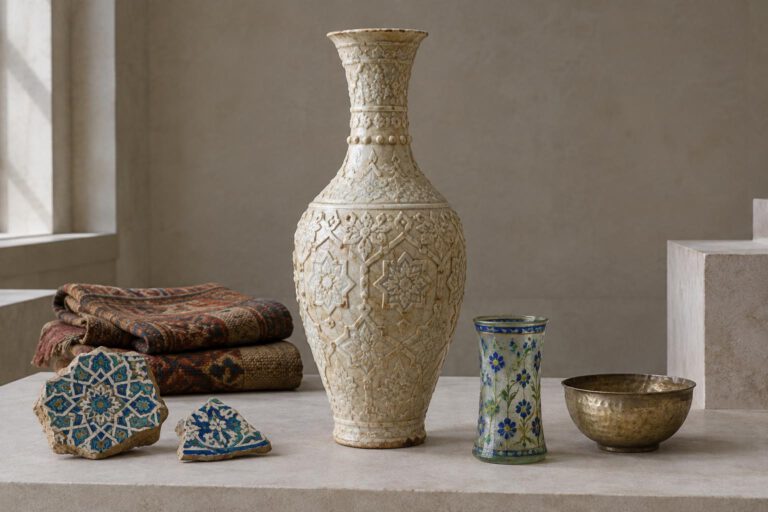
Karl Ernst Osthaus began collecting decorative arts from North Africa and West Asia in 1898 – before Renoir and van Gogh became the names with which the Folkwang collection would later be widely associated. Two journeys around the turn of the century, including stays in the Ottoman Empire, turned his attention towards art shaped by Islamic cultures. His collecting was not merely a footnote to his enthusiasm for modernism: it was part of a vision for a museum that sought to consider art, design and everyday life together.
The exhibition ‘NACH DAMASKUS … Karl Ernst Osthaus und die islamischen Künste’ (TO DAMASCUS … Karl Ernst Osthaus and the Islamic Arts) presents these holdings at Museum Folkwang from 6 November 2026. Around 300 objects – including ceramics, textiles, metalwork and glass – are intended to shed light on the collection and its influence. At the same time, it draws attention to a question that extends beyond Osthaus: who classified the art of the world, according to which criteria – and what can actually be documented about the journeys of individual objects?
Collecting as an idea for reform
Born in Hagen in 1874 and financially independent thanks to an inherited fortune, Osthaus founded the Folkwang-Museum there. It opened its doors in 1902. His collecting, however, began earlier and was broader in scope than a history of the European avant-garde might suggest. Museum Folkwang dates his first acquisitions of Islamic art to 1898. Around 1900, Osthaus expanded his interests to include East Asia, antiquity and European decorative arts.
This combination reflected a deliberate programme. The objects were not simply to be looked at; they were intended to offer artists and regional trades inspiration and standards of quality. The museum describes Osthaus’s aim as bringing together the fine and applied arts. Historical objects from different regions were thus placed in a shared context with contemporary design – an arrangement conceived at the time as a productive exchange, and one that today also invites questions about the power relations behind such categories.
One department, many histories
Over the years, a so-called ‘Islamic Department’ took shape in Hagen. Its holdings were not assembled entirely by Osthaus himself: subsequent museum directors also added to the collection, and further acquisitions were made in Essen. In 1922, following the founder’s death, most of the Folkwang collections were sold to the city of Essen, where they were merged with the municipal art museum. The Folkwang name and the institution moved with them, while the history of the Hagen museum remained part of the history of today’s collection.
According to the museum, the new exhibition also draws on former Folkwang holdings now housed elsewhere. Examples cited include part of the so-called Damascus Room, now in Dresden, and a 17th-century copy of the Persian ‘Šāhnāma’, the ‘Book of Kings’, which went to Berlin. Such references reveal that a collection is not an unchanging entity: works move, departments lose their coherence, and later museums adopt different priorities.
Provenance is not a verdict
Precision is needed when considering acquisition histories. The museum says that Osthaus collected the objects on his travels; this does not mean that the sellers, previous owners, dates and circumstances of acquisition are fully known for every individual piece. The publicly available information about the exhibition does not provide a comprehensive record of these object histories. An unresolved provenance – the documented history of ownership and changes of location – is not in itself evidence of unlawful acquisition. It marks, in the first instance, a gap in knowledge that may call for further research.
Nor is ‘Islamic art’ a timeless, uniform designation of origin. It brings together works from different regions, periods and workshop traditions under an overarching art-historical term. Folkwang has announced that it will broaden the historical perspective through contemporary artistic positions from Southwest Asia and North Africa, as well as specially commissioned works. The exhibition can thus reveal not only the collector and his system of classification, but also its limits: what becomes visible when the present and places of origin appear as more than mere additions to a European collection?
The museum reports that it has been conducting scholarly research into the holdings of the former department since 2019; restoration and conservation have also been part of the preparations. The extent to which specific journeys can be reconstructed for individual objects therefore remains a question that can only be answered by examining the relevant documentation. The exhibition’s value may lie precisely in treating these holdings not as an exotic precursor to modernism, but in considering their history, their influence and the unanswered questions together.
Original reviewed by the editors · 26 October 2026