Even before the first note, a concert hall tells its audience how to listen: you take a seat, look towards the front and let the music define the space for a while. What happens when that order no longer applies? Wien Modern, which has been taking place at numerous venues across the city since 30 October and continues until 30 November 2026, makes this question a guiding principle of its programme. The music does not simply change address. With the venue come changes in proximity, movement and the attention a work demands.
On 6 November, Jean-Luc Hervé’s “Un Monde Peuplé” takes audiences to the Zacherlfabrik. Conceived for three percussionists and multichannel electronics, the new work is described by the festival as a promenade concert: the audience can sit or move through the space; warm clothing is recommended. The venue is more than an unusual backdrop. Insect powder was once manufactured in the factory, and today it is home to bees. Hervé’s piece draws on this history. Even before a single sound can be described, a web of connections emerges between place, memory and ways of listening.
Space is not a neutral container
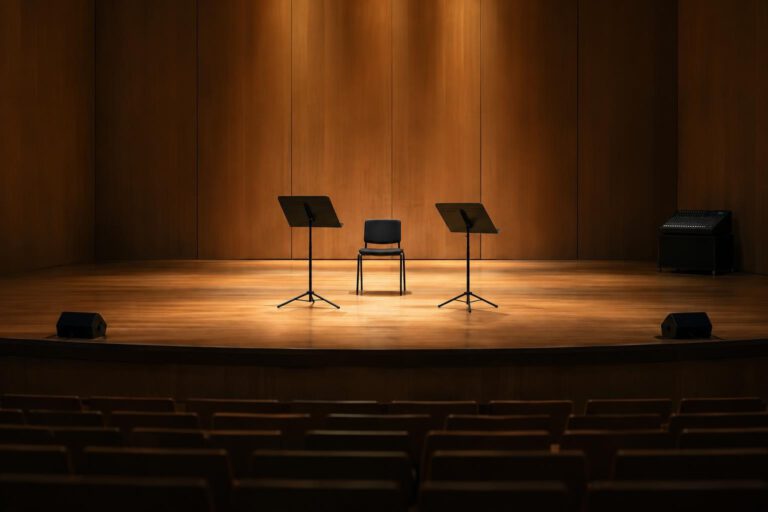
In a traditional concert hall, attention is usually focused. Audience and performers share a clearly structured space; the seating arrangement creates distance, but also stillness. In an installation or a promenade concert, this understanding can break down: those who move around do not listen from a fixed position, but encounter sound from changing directions and distances. This does not automatically make for a more intense experience. Movement can reveal new relationships in sound, but it can also distract; an unfamiliar venue can arouse curiosity while raising practical questions.
Bernhard Leitner’s exhibition “SOUNDSPACESCULPTURE” at the Secession, which runs until 22 November, also shows how deliberately such questions of space can be addressed. For decades, Leitner has explored sound as a means of shaping space. His works invite us not only to follow sounds as they unfold over time, but also to perceive them as movement in space. This distinguishes a sound installation from a concert without setting the two forms against each other: in one, listening itself can become a route through a space; in the other, the experience is sustained by a shared focus on a performance.
Not every place sounds the same
On 7 November, the programme features the world premiere of Liza Lim’s “Anima Mundi” in the Great Hall of the Wiener Konzerthaus. The piece for 24 musicians returns to an established concert format – but not as a countermodel to the other events. The hall offers conditions that matter for a large ensemble: a fixed performance time, an audience gathered together and an architecture that deliberately focuses sound. The comparison makes clear that a festival need not choose between hall and city. It can place the different forms alongside one another, making audible what each allows.
A change of venue, however, requires more than an artistic idea. Routes must be easy to find, spaces suitable for performance and dates coordinated with the respective venues. In a factory, temperature and freedom of movement can become crucial; an installation calls for different information and ways of accessing it from a seated concert. Accessibility and the question of how audiences reach a venue are also part of the practical reality of programming. Wien Modern flags up limited accessibility and the need for warm clothing at the Zacherlfabrik – a reminder that unusual venues are not automatically equally accessible to everyone.
A city as a listening space
When Wien Modern began in 1988, large halls and traditional concert formats were its focus. Since then, according to its own account of its history, the festival has developed into a platform encompassing many venues and formats. Stepping outside the hall is therefore not simply a search for variety. It also changes how new music appears in the city: as a concert, as a spatial experience, as an encounter with a particular environment.
What is gained in the process cannot be reduced to a general rule. A work may make its impact in a hall through concentration, and elsewhere through movement or the history of its surroundings. What matters is that the venue is not treated as a decorative addition. Where a festival takes it seriously, it organises not just performances but different conditions for listening – and leaves it to the audience to decide which it seeks.
Original reviewed by the editors · 3 November 2026