On 5 November 2026, John Berger would have turned one hundred. The anniversary is an occasion to return to a question his books ask again and again: where do we see from? Not just pictures, but one another too – and the world around us. For Berger, seeing is not an innocent preliminary to thought. It is already shaped by history, ownership and experience.
Today, this sounds self-evident. But that apparent obviousness is deceptive: an image never stands entirely alone. Who made it, who owns it, where it is shown and how it is reproduced – all these things change what it means. Berger’s strength lies in treating these conditions not as a footnote to art, but as part of what makes it visible.
The image has an address
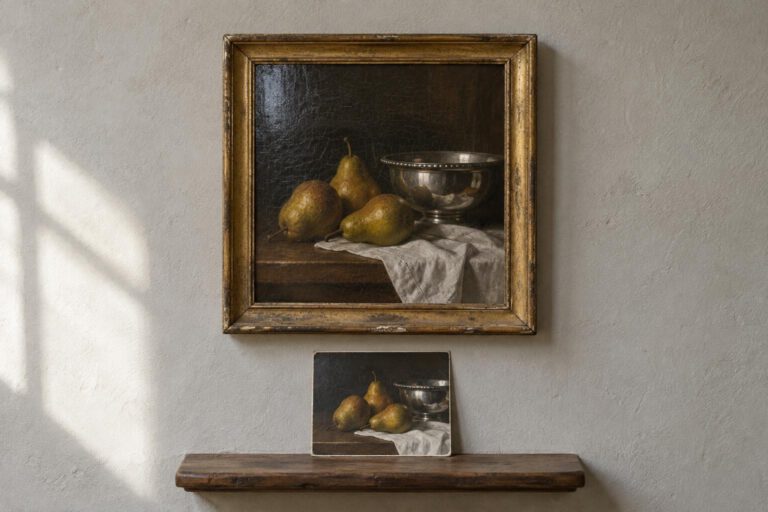
‘Ways of Seeing’, released as a book and television series in 1972, is less a manual on what works of art mean than a lesson in distrusting seemingly natural ways of looking. Berger draws attention to the circumstances in which images circulate: reproductions, captions, advertising and the familiar order of the museum. A painting once tied to a particular place can appear anywhere as a photograph – acquiring new neighbours, new purposes and new meanings in the process.
Nor does Berger regard the tradition of European oil painting as a timeless treasure house. He asks what conception of wealth and ownership it makes visible, and whose interests that vision serves. His critique of the depiction of women sharpens the same question: who looks, who is looked at, and who controls the frame? The often-quoted distinction between a male viewer and a female figure is not merely a judgement on individual pictures. It describes a power relation inscribed in gazes and pictorial conventions.
This method is effective precisely because it does not forbid the enjoyment of art. It makes it more demanding. We can still find a picture beautiful – while asking what social order that beauty helps to sustain. Berger erects no wall between form and politics. He looks for politics in form, in selection and in the angle of view.
From seeing to living together
In ‘A Seventh Man’, developed with the photographer Jean Mohr and published in 1975, this attentiveness extends to the experience of labour migration in Europe. Text and photographs do not simply illustrate the same subject. Their combination allows material reality and inner experience to coexist: work, distance, absence, the question of what a life in an unfamiliar place costs. The gaze turns towards people who often appear in society’s narrative only as workers.
Here it becomes clear that Berger’s art criticism and his literary writing are not two separate activities. Both refuse to take the visible as the whole story. An image shows something; language can ask about what remains outside the frame. Conversely, attention to concrete particulars guards against a language that treats people merely as examples of a theory. Berger seeks a form in which observation and judgement keep each other in check.
Yet this also reveals a limitation. Where Berger places images under suspicion of serving social interests, the interpretation can be settled too quickly. Not every detail can convincingly be traced back to ownership, class or gender; an image may resist its political reading, remain ambiguous or derive its effect precisely from formal decisions. Anyone who reads all beauty merely as a disguise for power may overlook what cannot be contained within a social explanation of art.
This objection is no reason to set Berger’s approach aside. It reminds us that close looking must also test its own certainties. The question of where we see from is addressed not only to the institutions that display images, or to the society that produces them. It applies equally to the critic, the reader, the viewer – and their desire to categorise what they see as quickly as possible.
A century after Berger’s birth, the continuing relevance of his books therefore lies not in a fully formed theory of seeing. It lies in an attitude: looking closely, remaining mindful of one’s own standpoint and leaving open what cannot be explained in full. Images are not innocent. But neither are they mute evidence for an argument. Berger gives the gaze a history – and leaves us responsible for it.
Original reviewed by the editors · 26 October 2026