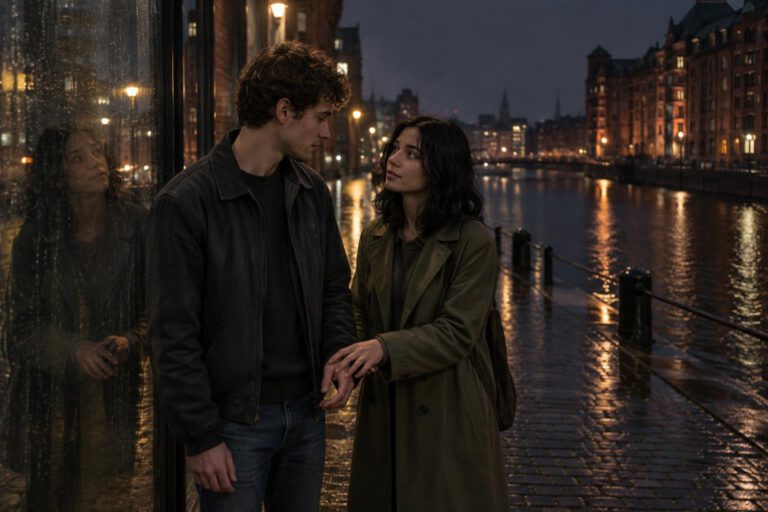
Absence has a paradoxical face in cinema: it is invisible, yet the camera can capture it. An empty seat, a room fallen silent, a face waiting for something – the image shows not loss itself, but its traces. Herein lies a particular power of film: it allows the past to return without actually bringing it back.
The German cinema release of Fatih Akin’s “Geister” on 5 November brings this question into focus. The film begins with a young love interrupted by death and opens up a space between dream and reality. In conversation with NDR Kultur, Akin also spoke about the personal significance of such images: people close to him who have died are, in a sense, preserved in his films. This is not a claim that a film can undo loss. Rather, it describes a form of remembrance that makes present what is irretrievably missing.
The image is not a return
The way film makes memory seem so immediate has to do with its material. Moving images capture gestures, faces and places – but always as a recording of a moment in the past. What feels present on screen is also already over. This tension is inherent in the medium: cinema can make time visible, but cannot turn it back.
Filming or showing an absent person therefore need not mean retelling their story. Often, the effect lies in what remains: a gaze directed towards someone, a movement that leads into emptiness, or familiar surroundings that have changed. Absence is then not illustrated like an object, but felt as a relationship – between what can be seen and what is missing.
Dream as a cinematic space in between
“Geister” makes dreams the narrative setting for a closeness no longer possible in everyday life. This is a long-standing feature of cinema: it can connect spaces and times that remain separate outside the film. A single cut is enough to leap from the present into a memory; repetition can transform a gesture; a face on screen can be both a person and an image held in memory.
In the NDR interview, Akin spoke about a black-and-white and a colour version of the film, as well as its graphic-novel aesthetic. He also cited Alfred Hitchcock’s “Vertigo” as an influence on its imagery. Such references promise no definitive interpretation and do not, in themselves, tell us how each scene is constructed. They do, however, indicate an interest in images that open up more than one level of reality: at the boundary between perception, desire and memory.
Grief without shortcuts
Films about death and loss can easily fall into two traps: presenting grief as a process that reaches completion, or turning it into decorative melancholy. Speaking to NDR Kultur, Akin stressed that he wanted to take the characters’ particular grief seriously rather than lose himself in “grief porn”. The term is provocative; behind it lies a question of craft: which images acknowledge pain without exploiting it?
One possible answer lies in duration. Cinema can stay with waiting, with repetition, with the inability simply to move on. It can also create closeness without denying absence. This is what distinguishes cinematic remembrance from a promise of consolation: the image preserves a moment, but it does not bring the person back.
Akin’s film also forms part of a distinctive career that moves between social observation, love stories and historical subjects – from “Head-On” through “The Edge of Heaven” to “Amrum”. “Geister” turns its gaze once again towards relationships and loss, this time with dreams as a threshold. Whether that threshold holds will be determined by the film itself. The question it raises extends beyond the cinema release: which images remain when someone is no longer there – and what can they do for the living?
Original reviewed by the editors · 1 November 2026