Ralle and Hannes have professions, a shared history and quite a lot of time on their hands. One was an engineer in opencast mining, the other a landscape architect; both have been unemployed for a long time. In “Warten auf’n Bus” (Waiting for the Bus), they sit at a bus stop in Brandenburg and talk. The premise alone challenges the notion that thinking is the preserve of big cities.
The world premiere of two new episodes is scheduled for 25 October 2026 at 7pm at the Berliner Ensemble’s Neues Haus: “on air” and “München kann jeder” (Anyone Can Do Munich), written by series creator Oliver Bukowski and Hannah Zufall. Max Hopp directs. A preview performance was already listed for 24 October. The premiere raises a question that reaches beyond this evening: who speaks for the provinces?
New texts, different means
Peter Moltzen plays Hannes, Gabriel Schneider Ralle. Rather than simply adapting familiar television episodes, the BE is continuing the characters’ stories with new texts. Hannah Zufall describes the difference from television as greater creative latitude in terms of content: theatre allows for more independent and perhaps more radical work, she told rbb ahead of the premiere.
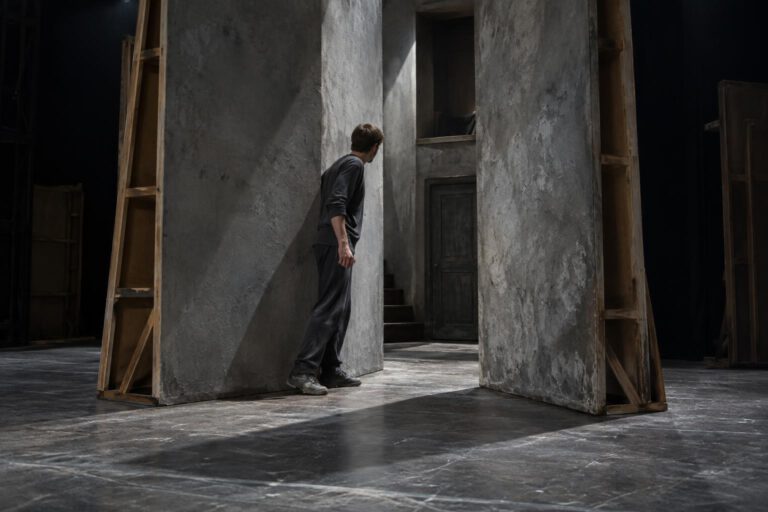
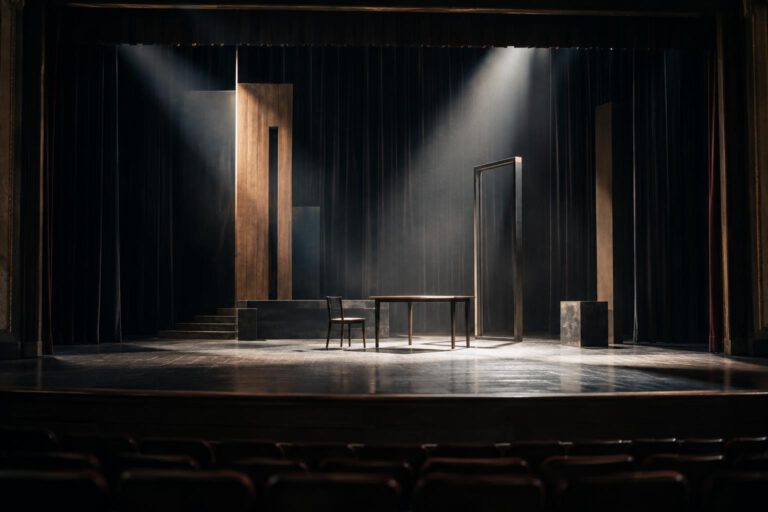
Hopp, meanwhile, identifies a formal challenge: where the camera can change its framing, the stage has to command attention through the pace of thought and vocal differentiation. Katja Pech is responsible for the set, Elina Schnizler for the costumes and Frédéric Dautier for the lighting; the music is by Doris Decker and Marlon Mausbach. Only the performance will reveal how these elements work together.
Two men are not an entire region
The bus stop initially offers a productive constraint: two people need not represent every circumstance of life in Brandenburg. Their working histories are as much a part of them as their unemployment, their friendship as much as their views. What will be interesting, then, is whether the production makes them recognisable as individuals with their own contradictions – or whether the audience primarily looks to them as representatives of a supposedly homogeneous East.
Dialect alone does not answer the question of connection either. It can make social experience audible; but it can equally become a marker that fixes an identity before the next sentence is spoken. In this preview, that is not a diagnosis of the production, but a question about the encounter between its characters and the metropolitan audience.
The countryside has long been speaking for itself
Outside Berlin, meanwhile, the issue is not just how one is represented on a stage in the capital. At a discussion at the Oderbruch Museum Altranft in November 2025, singer-songwriter Heike Mildner from Lietzen said: “We need spaces for conversation; they are important.” In the transcript published in 2026, she describes local reading groups. Following renovation work, poor acoustics had deterred older people from returning. Connection also comes, after all, from actually being able to understand one another.
In the same discussion, Almut Undisz, managing director of Theater am Rand in Zollbrücke, described a different route. The theatre had initially grown out of its founders’ artistic interests, rather than an identified need in the surrounding area. Its connection with the region had developed only gradually; the youth theatre club was deepening it further. Rural culture appears here neither as an untouched idyll nor as a void that Berlin needs to fill, but as the work of building relationships.
The BE production is billed as lasting two hours and ten minutes, including an interval; further performances are scheduled for 26, 28 and 29 October and 5 December 2026. Its two waiting men need not speak for everyone. A more intriguing prospect would be that they open our eyes to those who have long been having conversations of their own beyond the capital.
Original reviewed by the editors · 25 October 2026