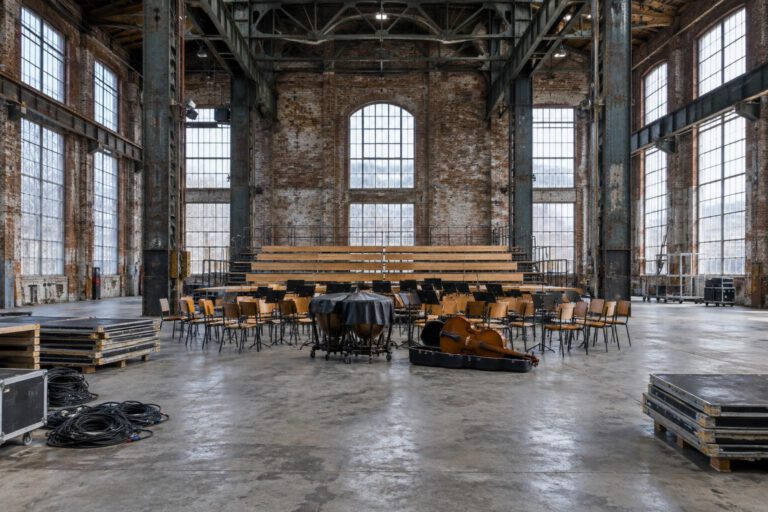
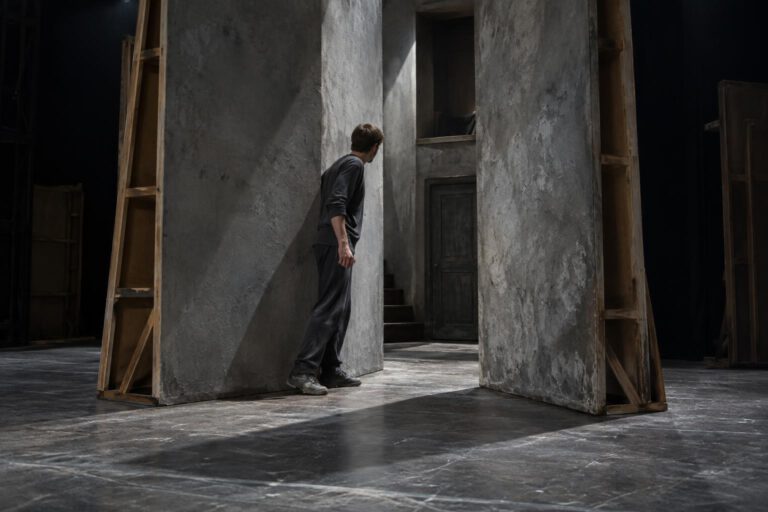
A hotel is not a home, but a place where paths cross. In Joseph Roth’s 1924 novel ‘Hotel Savoy’, returning soldiers, fortune-seekers and those left adrift encounter one another after the First World War. The floors map out the social divides: comfort below, cramped quarters above. The building becomes a model of a world that has lost its order.
On 7 November, Musicbanda Franui brings the novel to Vienna’s Burgtheater. Nicholas Ofczarek joins the ensemble on stage; the live music combines Roth’s text with operetta pieces from 1900 to 1935. The premiere is confirmed. The theatre has not yet provided further details of the Vienna production’s set and lighting design.
Music as a second narrative strand
What can music achieve when the aim is not simply to act out a novel? It can accompany the action, but also mediate between characters, shift moods and make contrasts audible. Operetta in particular offers a contradictory language for this: its melodies promise verve and lightness, while Roth’s hotel is marked by uncertainty and social hardship.
The combination is more than mere musical decoration. A cheerful number can sound different with different instrumentation or in a new context — as a memory of a lost normality, as defiance or as a crack in the glamour. The music does not dictate what a scene should mean. It opens up a second reading alongside the spoken text.
One building, many voices
Roth tells of people caught in a state of transition: the war is over, yet a secure future is nowhere in sight. The hotel brings them together under one roof without erasing their differences. On stage, music can mark such distances — through changing timbres, rhythms and the relationship between speech and song. Whether and how the Vienna version will distinguish individual characters musically remains an open question ahead of the premiere.
For years, Franui has worked with unusual combinations of folk music, classical music and other musical idioms. In Stuttgart in 2024, the Musicbanda gave the world premiere of its own stage version of ‘Hotel Savoy’. At the time, Andreas Schett described the musical work as a collective process of taking material apart and putting it back together. For Vienna, the Burgtheater credits Andreas Schett and Markus Kraler with composition and musical arrangements, Rita Czapka and Schett with the stage adaptation, and Tamara Metelka with shaping the text. These credits indicate a new adaptation; they do not establish that the Stuttgart production is being transferred unchanged.
A salon that offers no reassurance
The announced operetta hits come from an era whose light music often favoured glamour and confidence. Roth’s hotel, by contrast, is not a safe refuge but a setting for precarious lives. When the two meet, music cannot smooth over the social divides: instead, it makes audible just how close pleasure and despair lie to one another.
The premiere thus poses a theatrical question that extends beyond adapting the novel: can a song characterise a figure without reducing them to a mood? Can a familiar musical idiom carry history within it without explaining the scene? At the Burgtheater, Nicholas Ofczarek and Franui respond not merely by retelling the story, but by attempting to shape Roth’s hotel as a space of sound too.
Original reviewed by the editors · 3 November 2026