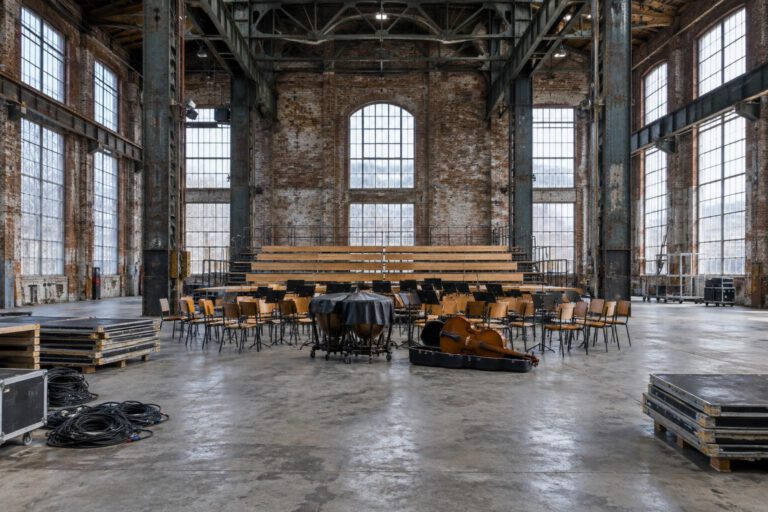
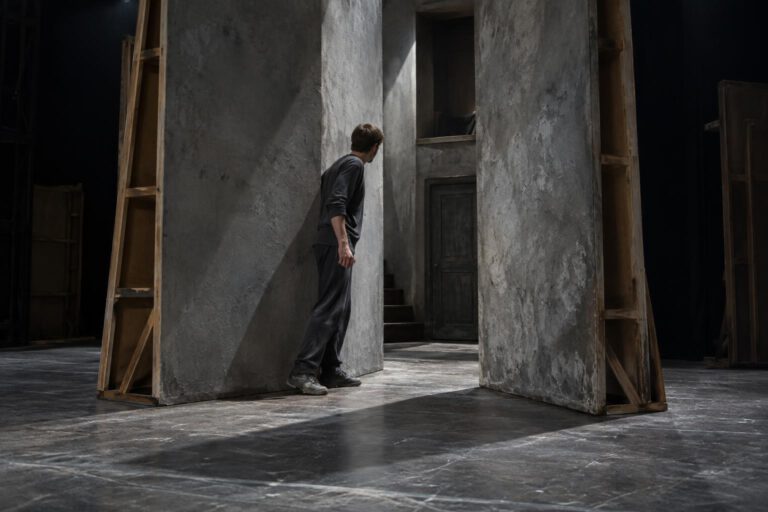
A judge is accustomed to distinguishing between assertion and evidence. A mother wants to trust her child. Suzie Miller’s ‘Inter alia’ begins where these two attitudes no longer sit comfortably together. Jessica Parks, a successful London judge, must confront an allegation against her son: Harry is accused of raping a fellow pupil. Suddenly, the question of justice concerns not only her profession but her family.
The German-language premiere is scheduled for 31 October 2026 in the Großes Haus at the Düsseldorfer Schauspielhaus, starting at 7.30pm. Anna Stiepani directs, with a translation by Anne Rabe. Meike Droste plays Jessica Parks, Philipp Hauß her husband Michael Wheatley and Theo Thun their son Harry. What makes this constellation interesting is not simply which convictions withstand pressure. It is also how quickly closeness can alter standards we took for granted.
Conviction meets another point of view
Miller, herself a lawyer, has already placed a female perspective on sexual violence and the justice system centre stage with ‘Prima Facie’. First performed in Australia in 2019, the play is a monologue. ‘Inter alia’, first staged at London’s National Theatre in 2025 with Rosamund Pike, directed by Justin Martin, now relocates that debate within a web of family relationships.
This shift has significant dramaturgical implications. A monologue can bind an audience closely to a single voice. Three characters at least open up the possibility that someone’s account of themselves will meet with immediate contradiction: what Jessica sees as care might feel like control to someone else involved; what sounds like consistency might emerge as evasion in the next conversation. Whether and how Stiepani brings out such tensions remains to be seen.
Yet the title itself challenges the idea of a single role that explains everything. ‘Inter alia’ means ‘among other things’. Jessica is not only a judge but also a mother, wife and friend. She also has a fondness for karaoke, which both theatres highlight in their descriptions of the play. On paper, at least, this detail prevents the character from appearing merely as the embodiment of a position. A woman with professional authority also has a life beyond her remit.
Openness is not indifference
Here lies an intriguing challenge for the Düsseldorf production: how can Jessica’s conflict be shown without immediately interpreting her every response? In the theatre, a pause between two answers can become as important as an argument. The distance between bodies can affirm or deny intimacy. Thurid Peine is responsible for set and costume design; the announcement offers no indication of the spatial form the family will be given.
Dramatic openness need not mean endorsing every perspective equally. Examining a mother’s bond with her son is not the same as refuting an allegation. Nor does a socially sound conviction in itself replace engagement with the particular person before you. These distinctions, in particular, could prevent the characters from becoming mere case studies.
No verdict in advance
The tension surrounding this premiere therefore also lies in the relationship between subject and form. A play about justice can invite audiences to examine their own certainties. But it can also tell them so unequivocally where they should stand that little room remains for them to move of their own accord.
Only the performance will reveal the balance Stiepani strikes. A productive expectation of ‘Inter alia’ would not be to go home without a position. Rather, it would be to distinguish more precisely: between understanding and excusing, loyalty and self-protection, a firm conviction and a refusal to allow oneself to be unsettled any longer.
Original reviewed by the editors · 29 October 2026