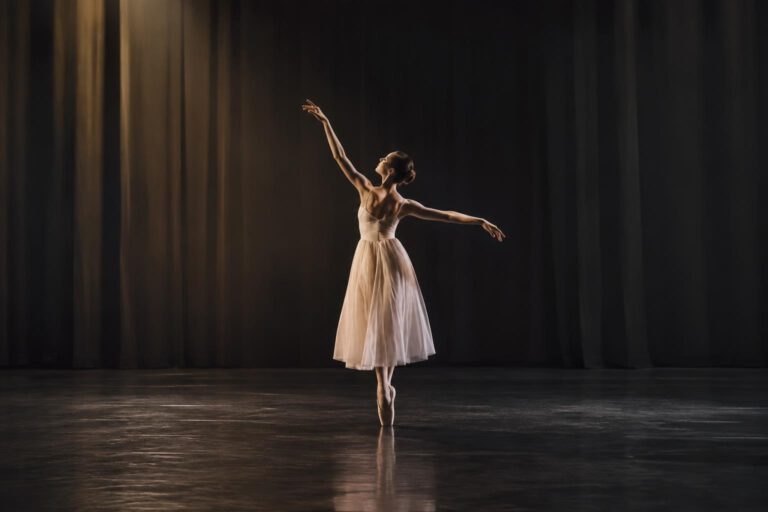
Ballet is an art of fixed forms – and precisely for that reason, fertile ground for new departures. The avant-garde does not begin only when pointe shoes disappear or the music falls silent. It can emerge when weight is shifted differently in a familiar step, bodies are grouped in a different way, or the relationship between movement and sound is reconfigured.
On Saturday, 31 October, the Semperoper Dresden stages three world premieres in “Different Grounds”. Stephanie Lake, Julian Nicosia and Shahar Binyamini are working with the Semperoper Ballett on different answers to the same question: what remains of classical ballet when its rules are treated not as an end in themselves, but as material?
Rupture Is Part of the History
The avant-garde is not a single style, but an attitude towards inherited traditions: taking form seriously enough to change it. An early turning point came with the Ballets Russes, which Sergei Diaghilev brought to Paris in 1909. Choreographers, composers and visual artists worked closely together there. Dance was no longer merely accompanied by music; sound, costume, stage design and movement formed a shared artistic construction.
“The Rite of Spring” by Igor Stravinsky and Vaslav Nijinsky, first performed in 1913, embodies a modernism that countered the classical ideal of harmonious lines with a more angular, rhythmically charged physicality. The scandal is part of its legacy, but it does not define the avant-garde. What mattered was the shift: the body no longer had to affirm a beautiful, self-contained form. It could make resistance, mass, rhythm and community visible.
Three Languages, One Company
“Different Grounds” does not put forward a single manifesto. The programme brings together three choreographic signatures which, according to the Semperoper, come from different dance traditions and were developed with the company. Lake choreographs “Quanta” to electronic music by Robin Fox. Fast, rhythmic passages alternate with movements that seem to unfold in slow motion. The title refers to the smallest units: the individual dancers become elements whose relationships form a larger order.
In Nicosia’s “A Quiet Collision”, an initially neoclassical language of group movement encounters an increasingly individual way of moving closer to the floor. Ballet vocabulary is not simply discarded, but stretched and fractured. Michael Anklin and Janiv Oron composed the music. The shift from a shared pattern to divergent individual movements makes the tension between order and instinct a choreographic principle.
Binyamini’s “Body Suites” poses a different question: how does the body relate to gravity? Its starting point is Johann Sebastian Bach’s cello suites, performed live by a cellist from the Sächsische Staatskapelle. Another distinctive feature lies in ballet’s classical hallmark: both female and male dancers perform in pointe shoes. The technique is used not as a nostalgic emblem, but as a physical challenge intended to make balance and groundedness legible in new ways.
Tradition as a Tool
The programme promises no radical departure from ballet history. Its experiments become comprehensible precisely through that history’s vocabulary: foot positions, pointe shoes, group formations. Rupture needs a form to push against. Here, then, the avant-garde lies less in the spectacle of the new than in the question of who orders movement – inherited technique, the music, the choreography or the dancers themselves.
Whether these three answers will come together on stage cannot be judged before the premiere. What is certain is that “Different Grounds” does not merely assemble different pieces, but makes change itself its subject. Ballet remains recognisable – and that is precisely what reveals how much potential for change its tradition holds.
Original reviewed by the editors · 30 October 2026