A festival is also a question of rhythm: you arrive when something begins, perhaps stay until the next set, and head outside with the music still in your body. A museum follows a different rhythm. You can linger, return, watch a film at your own pace. So when Creamcake brings its 3hd festival to the Berlinische Galerie, it is not simply a programme moving from one place to another. The rules of being together change.
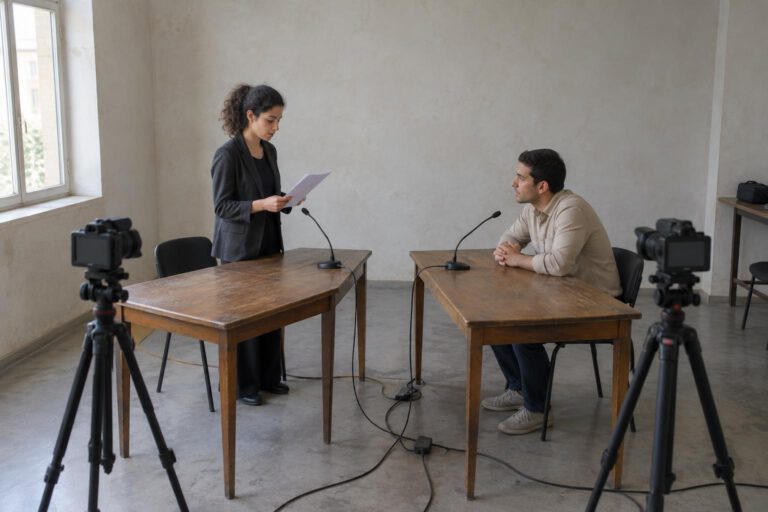
This is apparent in the format of the guest programme itself. On 29 October, “Headless”, a performance by Alex Quicho and Elizabeth Gabrielle Lee, opens the programme. It takes place in front of a painting from the Lovis Corinth retrospective; a DJ set by NAS TEA closes the evening. From the following day, four video works are shown in the gallery’s IBB Video Space, and are also available online via 3hdTV until 30 November. The festival evening is an event with a beginning and an end. The films, by contrast, remain available — in the museum and online.
A different rhythm of viewing
This shift is about more than logistics. Club culture and performance often work with duration, volume, physical proximity and an attention that is shared, but not necessarily focused on a single work. In the video space, by contrast, the image takes centre stage. Visitors can take their time; they can also move on. Concentrated viewing is possible, not guaranteed. The museum preserves film — while also changing how it is seen.
The four works revolve around images, power and the position of the audience. Sara Sadik’s “Ultimate Vatos: Force & Honneur” follows a character in a fictional military training programme that tests strength and belonging. Simone C Niquille’s “The Fragility of Life” takes a Hillary Clinton impersonator in the days before the 2016 US election as its starting point for reflecting on public images and the question of who controls them. Simona Andrioletti’s “Defence. What do you do with your anger?” assembles footage of people resisting various forms of violence; the material is filmed from a screen using a smartphone. Vika Kirchenbauer’s “This Suffocating Now” combines personal, archival and protest images with an exploration of political and social violence. The gallery describes the selection as asking what images allow us to remember — and what is forgotten when we look at them.
Andrioletti’s work in particular makes this change of setting a subject in its own right: those watching do not remain outside what is happening. Filming the screen adds another layer of mediation and draws attention to passive spectatorship. In the museum, this stance can be critically examined; at the same time, the audience in front of the screen remains, initially, an audience. A screening alone does not guarantee participation.
What the white space changes
The 3hd festival, organised by the Berlin-based platform Creamcake, is not confined to clubs. Its programme brings together performance, music and visual art at various venues and online. The Berlinische Galerie provides a dedicated infrastructure for this: since 2011, the IBB Video Space has shown time-based art — works in which duration and movement are integral to the work. For the museum, this is an opportunity to place video works in an institutional context; for a festival, it creates a longer window that extends beyond the evening.
There is a gain here, but not a neutral one. According to the festival, admission to “Headless” on 29 October is free; the film presentation is subject to the museum’s admission conditions. Online presentation broadens access beyond the exhibition space. At the same time, the social setting changes: an evening spent together with music and performance is not the same as a visit during regular opening hours or streaming at home. Who comes, how long they stay and whether conversations emerge cannot be gleaned from the programme alone.
What remains of the club in the museum is therefore not simply a toned-down night out. It is a different arrangement of attention: less fleeting, more clearly framed, accessible for longer. And what the museum takes from the festival is, at least, an attempt to treat art not merely as a silent object, but as a situation between image, body and audience. Whether this gives rise to a sense of community is not determined by the address. But the question of who is watching — and under what conditions — is explicitly part of the programme here.
Original reviewed by the editors · 26 October 2026